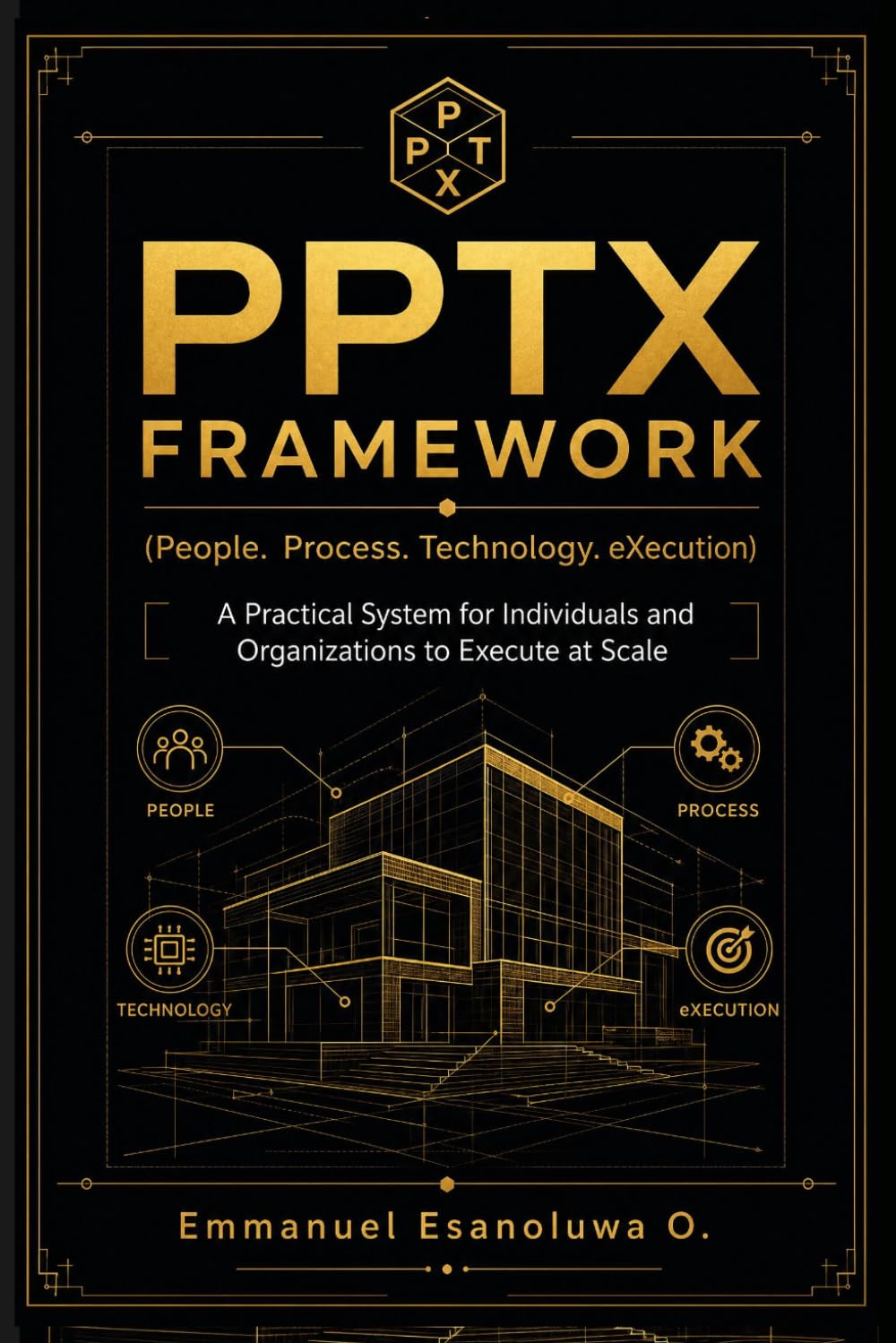
The PPTX Framework
People · Process · Technology · eXecution: A Practical System for Individuals and Organizations to Execute at Scale
Buy on Amazon
- Genres
- Business & Money, Business Development & Entrepreneurship, Entrepreneurship
- Language
- English
- Formats
- Paperback
- Pages
- 143
- Published
- September 1, 2026
Excerpt
Why Good Plans Need a Rhythm, Not More Motivation. The PPTX Framework Cadence FIELD NOTES One of the most consistent findings from my work across organizations is that the ones that execute reliably are not necessarily the ones with the best strategies. They are the ones with a predictable internal rhythm. I worked with an organization that had been trying to reduce operational cycle time for over a year. Every quarter, the same items appeared on the leadership agenda. Every quarter, they were deferred to the next meeting. The intervention was not a new strategy. It was a new rhythm. We introduced a weekly team check-in of no longer than thirty minutes with a fixed agenda: what committed actions moved last week, what is blocked, what moves this week. Within six weeks, the items that had sat on the leadership agenda for a year were either resolved or formally acknowledged as decisions that would not be made — both useful outcomes. The cadence did not generate the answers. It created a structure that forced the answers to surface. The second note is from an individual context. A senior professional I mentored was frustrated that her personal goals — learning a new skill, building her network, completing a writing project — never progressed despite genuine effort. We mapped her week together and found that her “goals” had no scheduled time and no review mechanism. Her urgent work always filled every available hour. Her goals were aspirations that had no cadence around them, and aspirations without cadence are just intentions with a deadline. We gave each goal a fixed time slot in her calendar and a brief Friday review of three questions: did I do what I committed to, what blocked me, what do I commit to next week. Within a month, the writing project was moving for the first time in two years. What a Cadence Is A cadence is a deliberately designed rhythm of review, commitment, and accountability that keeps execution visible and correctable in near-real-time. It is what prevents the silent drift described in Chapter 7 — the execution gap that opens in week two and is only discovered in month four. A cadence does not guarantee results. It guarantees that the distance between where execution stands today and where the strategy requires it to be is checked frequently enough to be corrected before the gap becomes fatal. The PPTX Framework places cadence inside the eXecution section deliberately. Process and Technology, covered in Parts II and III, define the system and extend its capacity. Execution is the human act of running that system, consistently, over time, under pressure. Cadence is the structural mechanism that makes consistent execution possible rather than dependent on exceptional individual discipline.